Articles
Why Is It So Hard to Find a Job in Germany?
📅 August 19, 2026 · Ferdi Şen
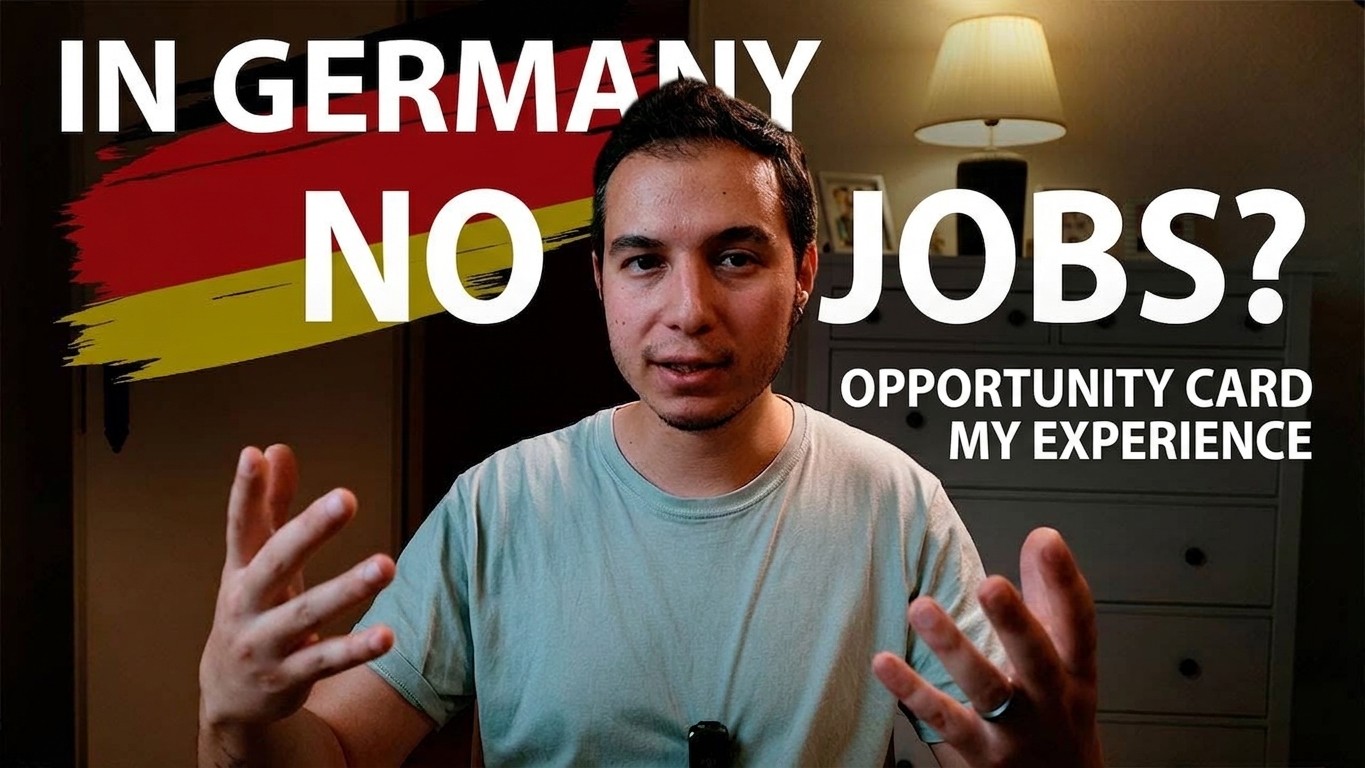
People say Germany needs 400,000 workers every year. So is there really no work in Germany? If that many workers are genuinely needed, why can't people who arrive on the Opportunity Card find a job easily? That's exactly what I want to talk about here. If you're thinking about coming to Germany on the Opportunity Card, don't come before reading this.
I myself came to Germany on the Opportunity Card visa, and I've since found a job and I'm working here. But Turks who were born and raised here, or who've lived here a long time, usually say "there's no work in Germany, everyone's unemployed." Meanwhile, the German state keeps issuing Opportunity Cards and job-search visas, trying to pull in workers from all over the world. And yet newcomers still struggle to find work, running into plenty of obstacles. I want to explain why this contradiction exists.
Why does Germany need workers?
That figure of 400,000 isn't calculated the way you'd calculate, say, "Mercedes needs 1,000 people, Siemens needs 500." It's a projection based on the country's average age, retirement rate, and population growth rate. To address this, the state offers incentives to raise the birth rate, provides daycare and childcare support so mothers can return to work after giving birth, and has raised the retirement age to 67. But under current conditions, that's not enough — outside labor is needed. That's exactly where the Opportunity Card visa comes in.
Here's an important point: that 400,000 figure doesn't mean "there are 400,000 open job postings right now." It's a projection made by foundations and research institutions looking ahead to 2050, that is, 20-30 years from now, based on Germany's aging population and birth rate. Today, that many people aren't actually needed; these steps are being taken for the future. Right now, staff are being sought everywhere, there's a shortage of skilled and semi-skilled labor, but things are still running one way or another. The real problem is that in 20 years, things could stop running altogether. Visa facilitations like the Opportunity Card and the job-search visa are a process the state is leading to head that off.
Before the Opportunity Card: the job-search visa
Before the Opportunity Card, there was the "job-search visa." With this visa, people could come to Germany for six months to look for work, and once they found a job, they'd move straight into a residence and work permit. But applying for this visa genuinely required you to be qualified: either a university graduate or someone who'd reached a very good level in their profession, and on top of that, you had to prove you could support yourself financially during those six months of job-hunting, with a blocked account or a guarantor. This system ran until 2024.
Over time, the state said: a person might not find work in their own field, their language might not be good enough, their experience might fall short. So let's also allow them to work in another qualified job outside their field; let them come, get used to the language, find a temporary job, with the real goal being to eventually return to their own profession. With this flexibility, the Opportunity Card visa was introduced on June 1, 2024, and the job-search visa was shelved. Right now, the job-search process continues under the name of the Opportunity Card visa.
So why is finding a job still so hard?
And here's the real question. If that many workers are needed, why can't people find a job right away when they arrive in Germany? The state wants to attract qualified people to the country, and it does, but it doesn't put employers under any obligation like "I brought these people here, so you have to hire them." Hiring is entirely the employer's own decision. When an employer looks at a candidate, they pay attention to things like: how useful will this person actually be to me, do they speak German, can I communicate well with them, can I trust their training? The employer picks whoever will be most useful to them.
So if you're not good at your profession, not experienced enough, don't have enough work experience, or don't speak German, finding a job is genuinely hard. Especially in professions like architecture or engineering, you can't find work just by knowing Turkish and working alongside other Turks, because Turks are basically nonexistent in those sectors. Finding work here without German — I'm not saying this just to say it — is genuinely very hard.
Is working outside your field a way around it?
If you don't have those things, you might consider working "outside your field," but the Opportunity Card doesn't leave that wide open either. The Foreigners' Authority (Ausländerbehörde) reviews whether the job you've applied for is actually a good fit for your qualifications. For example, if you come as a doctor and apply for a courier job, that mismatch won't be accepted; the authority will reject it. But working in another qualified field is possible: an electrical engineer, for instance, can work as an electrician instead of in engineering. But if that same engineer wants to work as a waiter, the authority won't easily approve that either. The Opportunity Card removes the requirement to work in the field you trained in, but it doesn't remove the "qualified job" requirement; you can't work in unqualified jobs.
Conclusion
If you don't speak German or aren't good enough in your profession, you won't easily find a job in Germany; don't apply for the Opportunity Card visa without knowing this. Especially if you're planning to risk everything — selling your belongings, taking out loans, putting everything you have on the line — think about it not once but ten times before you decide. All of us come here for a better life, a better future; our reasons may differ, but don't let coming here turn into a disappointment for you. Take this step by thinking realistically about what's ahead and what you're leaving behind.
I hope this article has been useful to you, and that it's clarified your perspective on the Opportunity Card and on Germany a bit more. If there's anything you're curious about, feel free to write it in the comments.
Ferdi Şen
Watch the Video
You can also watch me talk about this on YouTube.